Aware that robotics, programming, and computational thinking are now essential skills for the future professional and social development of students, the Regional Ministry of Education, Science and Universities and the Regional Ministry of Digitalization of the Community of Madrid have launched the Código Escuela 4.0 Program, an ambitious initiative aimed at integrating robotics into classrooms.
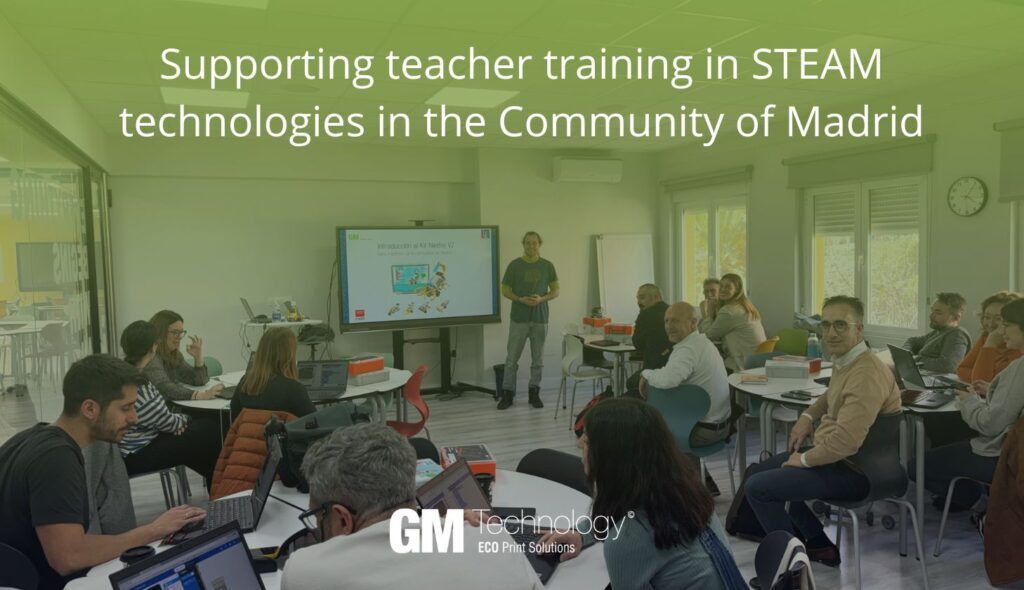
At GM Technology, we have been awarded Lot 4, covering the supply, content creation, and training of mentors and teachers within this large-scale project. Our goal has been to train teachers from the third cycle of primary education to effectively use innovative technological tools in their teaching methods. On this journey, we have received crucial support from Ingenio Triana, our key partner in the development and implementation of the training process and content creation, and Leal Educa, an essential partner in supplying the equipment. Thanks to their experience, high-quality audiovisual and didactic materials have been developed, helping teachers better grasp key concepts and ensuring they have innovative resources for teaching robotics in the classroom.
A project driven by key institutions
The Código Escuela 4.0 Program is part of the Recovery, Transformation, and Resilience Plan, funded by the European Union’s Next Generation EU funds. The Community of Madrid promotes this initiative to equip educational centers with advanced technologies and ensure that teachers receive proper training for classroom implementation.
This effort has involved several entities:
-
The Ministry of Education, Vocational Training and Sports, leading the national strategy for educational digitalization.
-
The Community of Madrid, responsible for resource distribution and coordination of teacher training.
-
The Regional Ministry of Education, Science and Universities.
This project addresses the need to prepare students for future technological challenges, aligning with the LOMLOE (Organic Law of Education) and promoting STEAM-based learning (Science, Technology, Engineering, Arts, and Mathematics).
Commitment to digitalization and STEAM education
Digital transformation in education is a priority for the Community of Madrid, aiming to reduce the digital divide and promote the use of technology as a learning tool. Teaching robotics empowers students to not only consume technology, but also to become creators of innovative solutions.
In this regard, the region has reinforced its commitment to STEAM education by facilitating the incorporation of technological tools into schools. As a result, many teachers now have the opportunity to train in educational robotics and programming — both key elements in developing critical thinking and problem-solving skills.
Empowering teachers for STEAM teaching
At GM Technology, we have designed a structured training program to help teachers acquire not only technical knowledge, but also pedagogical strategies to integrate robotics into the school curriculum.
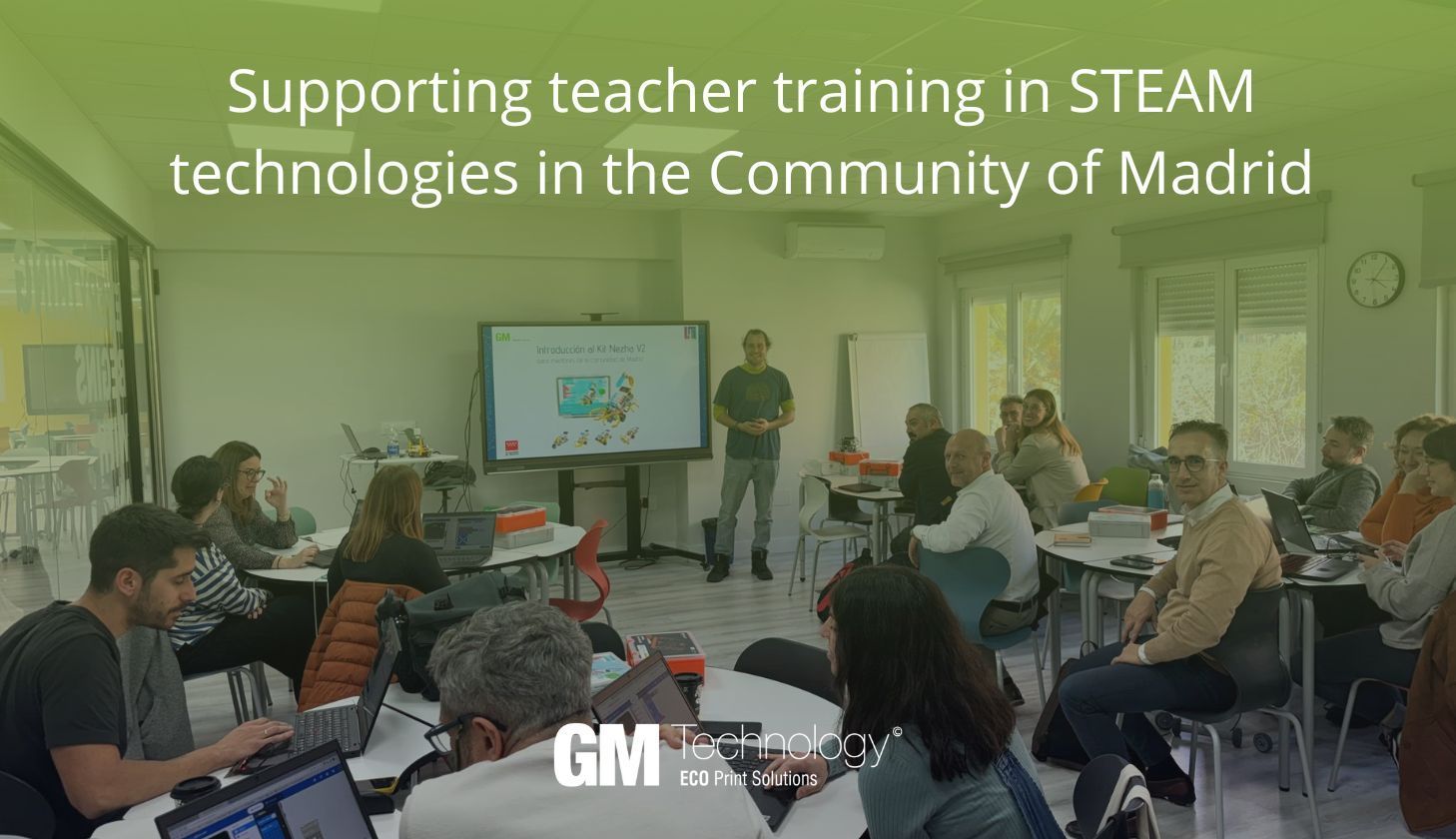
To ensure effective implementation of educational robotics in schools, GM Technology has delivered specialized training aimed at educational mentors and administrative technicians.
This training has been key for experts to offer both technical and pedagogical support to teachers, ensuring proper use of the technological equipment supplied in the program.
It includes:
-
Training in the use of technological equipment, focused on configuration, maintenance, and troubleshooting.
-
Instruction in didactic methodologies for teaching robotics and programming, ensuring teachers can integrate these tools into daily lessons.
-
Creation of STEAM-based projects, encouraging interdisciplinary learning and skills like critical thinking and problem-solving.
-
Strategies to integrate robotics into subjects like mathematics, science, and art, fostering a hands-on and experiential approach in the classroom.
Thanks to this training, mentors and technicians have acquired practical skills and pedagogical knowledge, becoming key figures in supporting teachers as they implement educational robotics.
The kits used in training
A critical component of the program has been the use of three key technological kits for teaching robotics across educational stages:
Micro:bit
A compact programmable board, ideal for teaching computational thinking and programming logic.
Capable of connecting with sensors and actuators for interactive project development.
NEZHA
A STEAM kit based on Micro:bit, allowing exploration of sensors, motors, and mechanical structures.
Compatible with block-based programming, making it accessible to students of various educational levels.
Educational Robotics Kit for Micro:bit
A modular set that expands Micro:bit’s capabilities, enabling the construction of robots and educational prototypes.
Designed for primary education and advanced projects.
These kits were selected for their versatility, accessibility, and ease of use, ensuring that teachers can incorporate them into their lessons without difficulty.
A high level of satisfaction
One of the most important achievements of this project has been the overwhelmingly positive reception by teachers and educational institutions. After completing the training, mentors and teachers expressed a high level of satisfaction, highlighting:
-
The usefulness of the robotics kits, which support active learning methodologies in the classroom.
-
The clarity and dynamism of the training sessions, which made technical concepts easier to understand.
-
The positive impact on their teaching methods, promoting hands-on, experiential learning.
This positive assessment was confirmed by Margarita Vila Gómez, from the General Directorate of Bilingualism and Quality of Teaching of the Regional Ministry of Education, Science and Universities, who remarked:
“The level of involvement in the project and the quality of the materials provided have been exceptional — truly deserving of top honors.”
The program’s impact on education
The Escuela 4.0 Program is more than just a temporary project; it represents a shift in how teaching and learning take place. Thanks to this initiative:
-
Teachers are better equipped to face digital challenges.
-
Students gain access to technologies that inspire creativity and innovation.
-
Public education in Madrid takes a leap forward in integrating technological tools into the classroom.
At GM Technology, we are proud to be part of a project of this scale, contributing to the modernization of the educational system and the development of digital competencies in teachers.
Looking ahead
This is just the beginning. Digital transformation in education is an ongoing process, and at GM Technology, we will continue to support teacher training and technological innovation.
We remain committed to education — today and always.